
7 Oct, 2026
Empty Egg Cases of the Vapourer Moth
This neat cluster of egg cases, tucked into a crevice in the bark, was laid by a Vapourer moth. Each egg is a little bead, slightly flattened top and bottom, creamy white with a chocolate-brown ring and a dark central spot. Here there are a couple of hundred of them, packed together like a tiny cobbled pavement.
The female Vapourer is almost wingless and cannot fly. She emerges from a silk cocoon (seen here at the top left) spun on a twig, fence or wall, then simply stays put, releasing a scent that draws in the rusty-brown, day-flying males. After mating she lays her entire batch of eggs on the outside of her own empty cocoon, often dying beside them. The eggs overwinter there and hatch in late spring, when the tiny hairy caterpillars disperse, sometimes ballooning away on silk threads.
Not every egg produced a caterpillar, though. Look closely and a few are still plump, pearly-white domes, and a small group near the lower left edge is darker brown overall. Some of these may simply have been infertile, but others have probably been attacked by a tiny parasitic wasp. The most likely culprit is Telenomus dalmanni, a minute scelionid wasp recorded as an egg parasitoid of the Vapourer in Britain. The female wasp lays a single egg into each moth egg. Her larva eats the contents, and the shell usually darkens as it develops. The adult wasp then chews a small round exit hole and flies off to find the next egg batch.
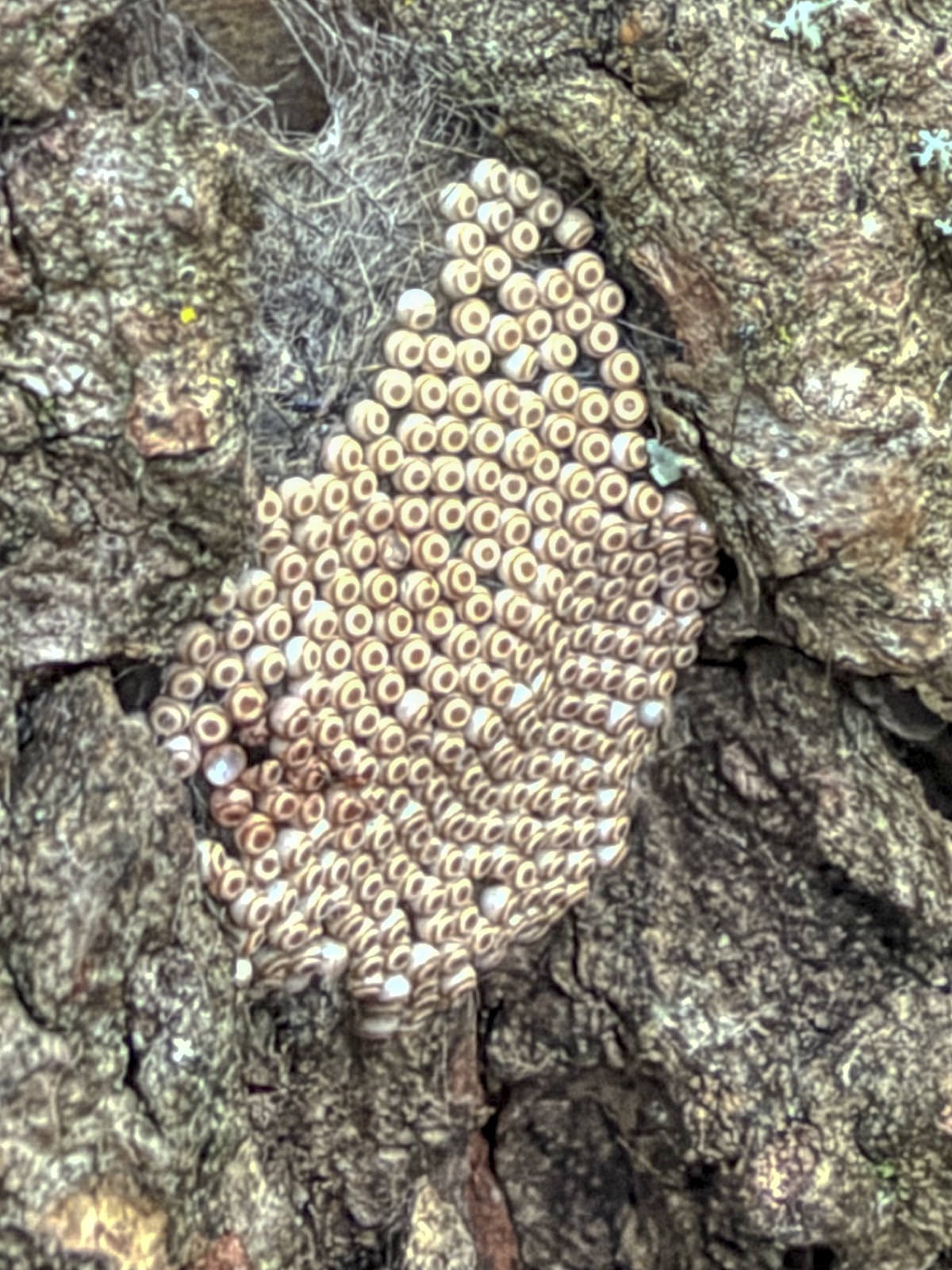
Empty Egg Cases of the Vapourer Moth – Orgyia antiqua