4 Nov, 2026
Green Elfcup, Chlorociboria aeruginascens
Spotted on a recent field meeting, this distictive fungi is an ascomycete (cup fungus). The fruiting bodies are tiny, usually 2–5 mm across, and a vivid turquoise to verdigris blue-green throughout. Young cups are cup-shaped on a short, often off-centre stalk. With age they flatten into small wavy discs. They appear mainly from late summer to autumn. They often grow in small clusters on the underside of fallen branches or logs.
The fruiting bodies are the less common sight. The mycelium stains the wood it grows through a deep blue-green, and that staining persists all year. It is far more often found than the cups. Any rotten stick that looks green all the way through is almost certainly this species or its relative
The green colour comes from xylindein, a naphthoquinone pigment. It is remarkably stable: it resists fading from light and stays in the wood for decades or even centuries.
From the 15th century, Italian craftsmen made elaborate wooden inlay panels in churches and studioli. They deliberately sought out “green oak,” wood naturally stained by Chlorociboria, because it was one of the few stable natural greens available to them. Some of these panels still show the colour today.
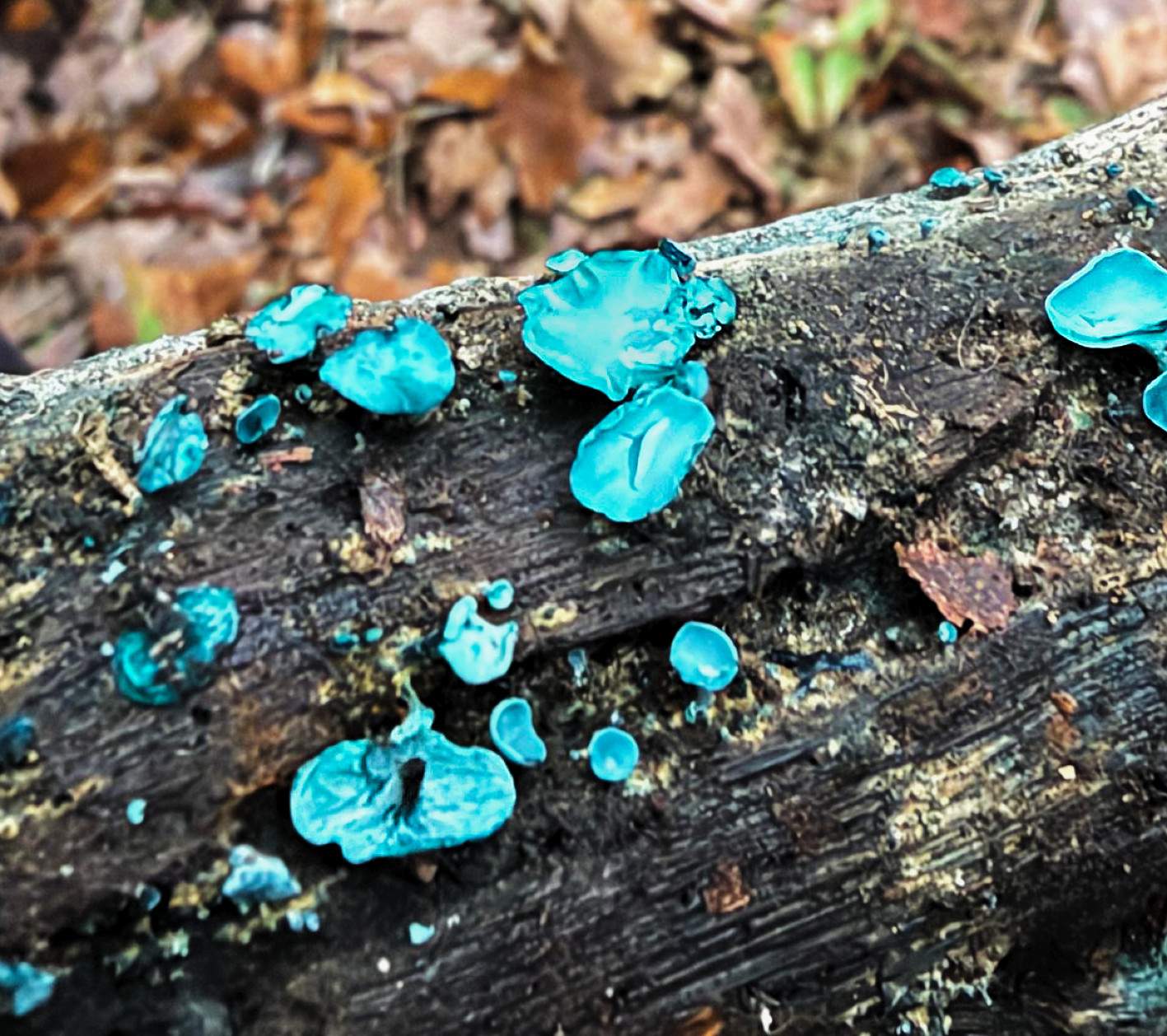
Green Elfcup, Chlorociboria aeruginascens