
4 Nov, 2026
Yellow Stagshorn, Calocera viscosa.
Found on an old conifer stump on a recent field meeting, this distictive fungi was identified as Yellow Stagshorn, Calocera viscosa. It is common across Britain, grows only on conifer wood (often buried roots), and can be found in most months, though it is most obvious from late summer to December.
It looks like a coral fungus but is actually a jelly fungus. The quickest test is a gentle squeeze: true corals are dry and brittle, while the stagshorn is rubbery, greasy and sticky when wet, hence viscosa. Its orange-yellow branches, up to 10 cm tall, fork repeatedly from a single base.
It appears that the first scientist to describe it was Alexander von Humboldt, in 1793. He’s the explorer who later mapped South America and has more species, places and features named after him than almost anyone. Yet his name for this little fungus, Clavaria aurea (“golden club”), was thrown out because someone had already used it for a different species. No doubt he was a little miffed about that!
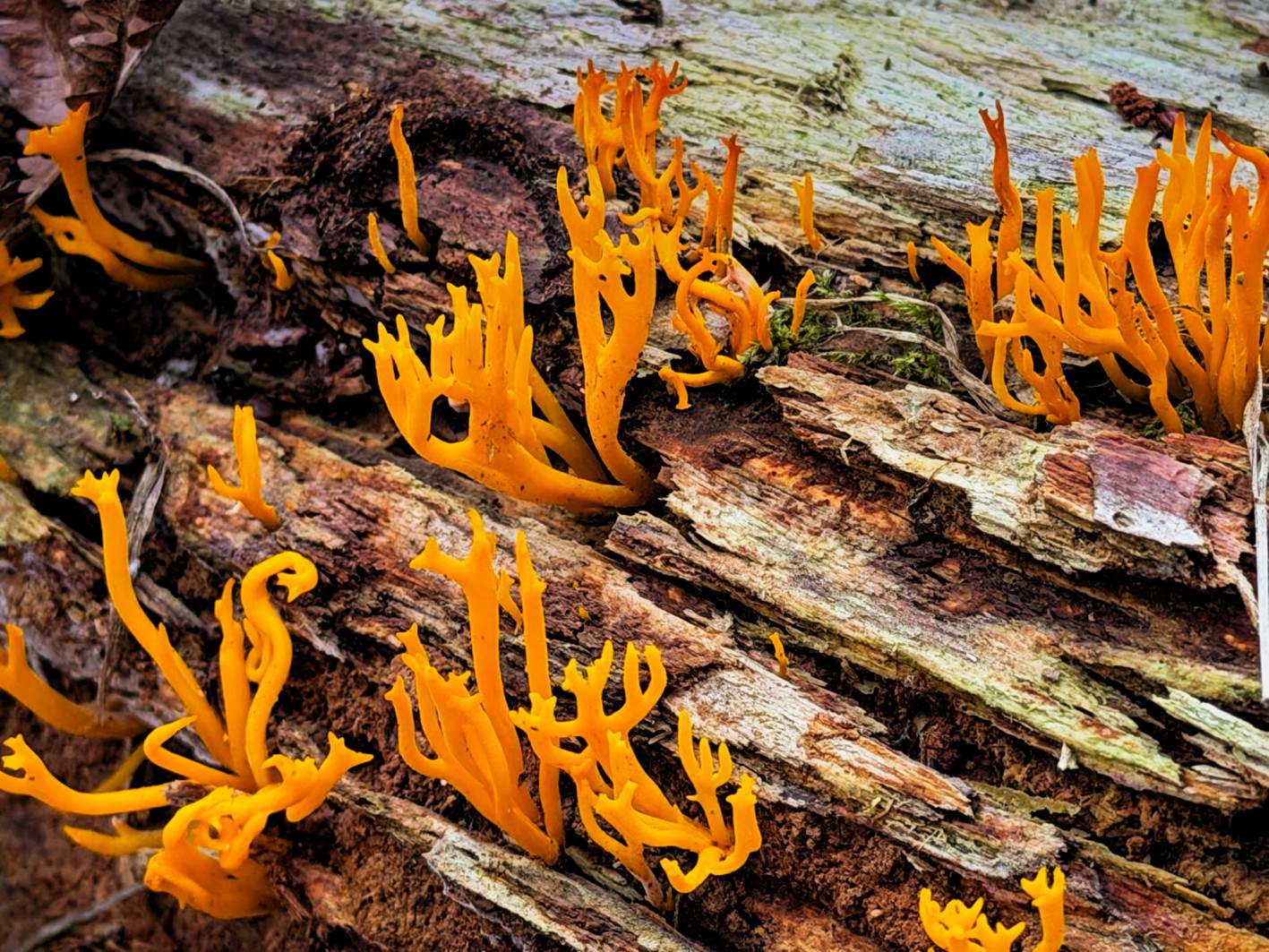
Yellow Stagshorn, Calocera viscosa.